


You can find details about how to access information remotely in this step-by-step guide. The guide will also help if for any reason you have difficulty accessing the content you want.
What would you like to know about this journal?
Impact factor: 2.9*
Eigenfactor Score: 0.07224*
Time to first decision (all decisions): 28.0 days**
Time to first decision (peer reviewed only): 34.0 days***
CiteScore: 5.5****
Indexed in MEDLINE and Web of Science
Chair: Anouk Rijs
Deputy Chair: Henry Schaefer
Article submissions (2023): 6335
Article publications (2022): 3016
Open access publishing options available
Journal scope
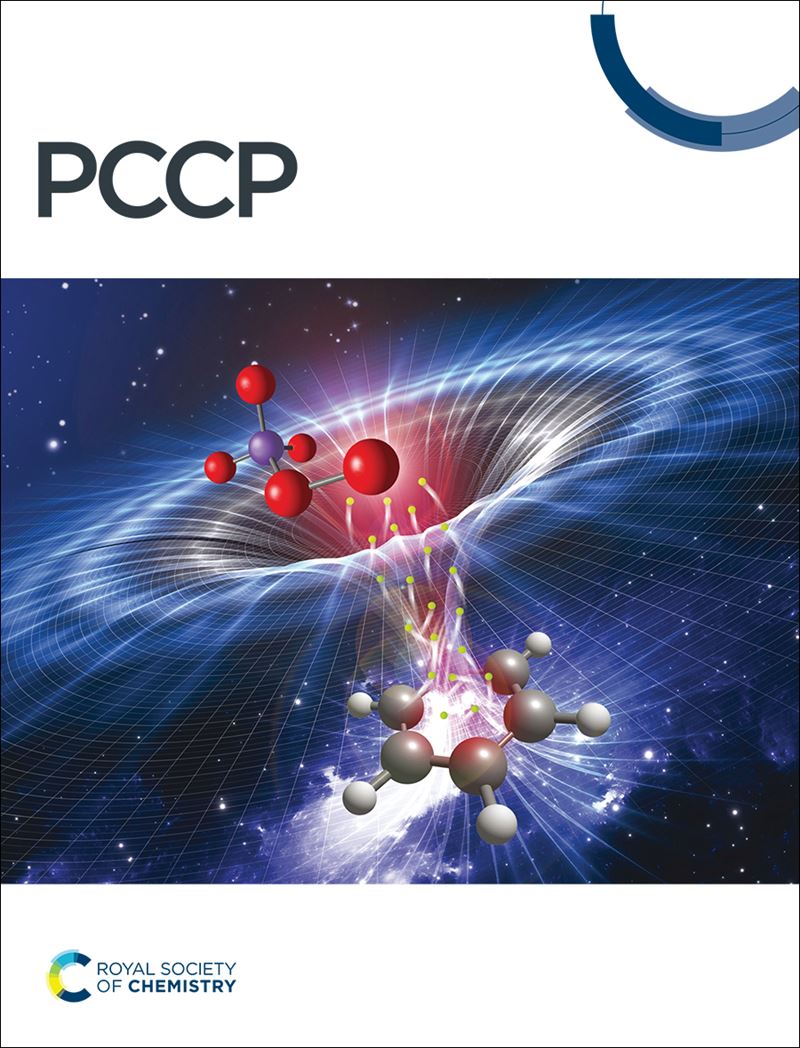
Physical Chemistry Chemical Physics (PCCP) is an international journal co-owned by 19 physical chemistry and physics societies from around the world. This journal publishes original, cutting-edge research in physical chemistry, chemical physics and biophysical chemistry. To be suitable for publication in PCCP, articles must include significant innovation and/or insight into physical chemistry; this is the most important criterion that reviewers and Editors will judge against when evaluating submissions.
The journal has a broad scope and welcomes contributions spanning experiment, theory, computation and data science. All contributions, including computational ones, should be based on up-to-date approaches. Topical coverage includes spectroscopy, dynamics, kinetics, statistical mechanics, thermodynamics, electrochemistry, catalysis, surface science, quantum mechanics, quantum computing and machine learning. Interdisciplinary research areas such as polymers and soft matter, materials, nanoscience, energy, surfaces/interfaces, and biophysical chemistry are welcomed if they demonstrate significant innovation and/or insight into physical chemistry. Joint experimental/theoretical studies are particularly appreciated when complementary.
Discover the PCCP Owner Societies
PCCP is co-owned by a group of 19 chemistry, physical chemistry and physics societies from around the world.








PCCP Emerging Investigator Lectureship
This lectureship recognises early career researchers, who have made a significant contribution to physical chemistry, chemical physics, or biophysical chemistry, in their independent academic careers.
Nominations are currently open until 5 April 2025, with a new winner being announced mid 2025.
Read about eligibility, how to nominate, and see all previous winners
See who's on the team
Meet the PCCP Chair and other board members.
Chair
Anouk Rijs, Vrije Universiteit Amsterdam,The Netherlands
Deputy chair
Henry Schaefer, University of Georgia, USA
Associate editors
Maria Lucia Curri, University of Bari, Italy
Wolfgang Ernst, Graz University of Technology, Austria
Keith Gordon, University of Otago, New Zealand
Lars Goerigk, The University of Melbourne, Australia
Hiroshi Kondoh, Keio University, Japan
Jer-Lai Kuo, Institute of Atomic and Molecular Sciences, Academia Sinica, Taiwan
Sabrina Leslie, Michael Smith Laboratories, Canada
Prabal Maiti, Indian Institute of Science, India
Spiridoula Matsika, Temple University, USA
Andrea Russell, Southampton University, UK
Isaac Tamblyn, University of Ottawa, Canada
Yunjie Xu, University of Alberta, Canada
Guochun Yang, Yanshan University, China
Michael A. Rowan, Executive Editor
Edward Gardner, Deputy Editor
Bee Hockin, Development Editor
Andrea Carolina Ojeda-Porras, Development Editor
Sam Keltie, Publisher, ORCID 0000-0002-9369-8414
Gisela Scott, Editorial Manager
Chris Goodall, Associate Editorial Manager
Catherine Au, Publishing Editor
Isobel Darlington, Publishing Editor
Konoya Das, Publishing Editor
Alexandre Dumon, Publishing Editor
Charley James, Publishing Editor
Amy Lucas, Publishing Editor
Kieran Nicholson, Publishing Editor
Rini Prakash, Publishing Editor
Daphne Houston, Editorial Assistant
Robert Griffiths, Publishing Assistant
C Adamo, ENSCP Chimie Paris Tech, France
Hans Ågren, KTH Royal Institute of Technology, Sweden
Ayyappanpillai Ajayaghosh, CSIR-National Institute for Interdisciplinary Science and Technology (NIIST), India
Bo Albinsson, Chalmers University of Technology, Sweden
Katsuhiko Ariga, National Institute for Materials Science, Japan
Paul Ayers, McMaster University, Canada
Piero Baglioni, University of Florence, Italy
Luis Bañares, Universidad Complutense de Madrid, Spain
Vincenzo Barone, Scuola Normale Superiore di Pisa, Italy
Malgorzata Biczysko, Wroclaw University, Poland
Evan Bieske, University of Melbourne, Australia
Julie Biteen, University of Michigan, USA
David Casanova, Donostia International Physics Center, Spain
Piergiorgio Casavecchia FRSC, University of Perugia, Italy
Ove Christiansen, University of Aarhus, Denmark
G Andres Cisneros, University of North Texas, USA
Sonia Coriani, Technical University of Denmark, Denmark
Chantal Daniel, Institute of Chemistry, University of Strasbourg, France
Mattanjah DeVries, University of California Santa Barbara, USA
Cristina Díaz, Universidad Complutense de Madrid, Spain
Jairton Dupont, University of Nottingham, UK
Shirin Faraji, University of Groningen, Netherlands
Daan Frenkel, University of Cambridge, UK
Asuka Fujii, Tohoku University, Japan
Laura Gagliardi, University of Minnesota, USA
Marie-Pierre Gaigeot, Universite d'Evry val d'Essonne, France
Subi George, Jawaharlal Nehru Centre for Advanced Scientific Research (JNCASR), India
Robert (Benny) Gerber, Hebrew University Jerusalem, Israel
Debashree Ghosh, Indian Association for the Cultivation of Science, India
Daniella Goldfarb, Weizmann Institute of Science, Israel
Stefan Grimme, University of Bonn, Germany
Martina Havenith, Ruhr-University Bochum, Germany
Krister Holmberg, Chalmers University of Technology, Sweden
Yasuhiro Iwasawa, University of Tokyo, Japan
Denis Jacquemin, Université de Nantes, France
Thomas Jagau, KU Leuven, Belgium
Erin Johnson, Dalhousie University, Canada
Seong Keun Kim, Seoul National University, Korea
Julie MacPherson, University of Warwick, UK
Hedi Mattoussi, Florida State University, USA
Frank Neese, Max Planck Institute for Chemical Energy Conversion, Germany
David Nesbitt, University of Colorado, USA
Dan Neumark, UC Berkeley, USA
Modesto Orozco, IRB Barcelona - Parc Científic de Barcelona, Spain
Katya Pas, Monash University, Australia
G Naresh Patwari, Indian Institute of Technology Bombay, India
Marie-Paule Pileni, Université Pierre et Marie Curie, France
Martin Pumera, Central European Institute of Technology, Brno, Czechia
Pekka Pyykkö, University of Helsinki, Finland
Mary Rodgers, Wayne State University, USA
Srinivasan Sampath, Indian Institute of Science Bangalore, India
Ruth Signorell, ETH Zurich, Switzerland
Timothy Schmidt, University of New South Wales, Australia
Martin Suhm FRSC, University of Göttingen, Germany
Arthur Suits, University of Missouri, USA
Dage Sundholm, University of Helsinki, Finland
Toshinori Suzuki, Kyoto University, Japan
Alessandro Troisi, University of Liverpool, UK
Shimon Vega, Weizmann Institute of Science, Israel
David Waldeck, University of Pittsburgh, USA
Li-jun Wan, Institute of Chemistry, Chinese Academy of Sciences, China
Bert Weckhuysen FRSC, Utrecht University, The Netherlands
Xueming Yang, Dalian Institute of Chemical Physics, Chinese Academy of Sciences, China
Anne Zehnacker-Rentien, Université Paris-Sud 11, France
John Zhang, NYU Shanghai, China
G Ertl HonFRSC, Berlin, Germany
B Feringa, University of Groningen, Netherlands
S W Hell, Max Planck Institute for Biophysical Chemistry, Germany
J Jortner FRSC, Tel Aviv, Israel
M Karplus, Harvard University, USA
K Kohse- Hoeinghaus, Universitaet Bielefeld, Germany
Y T Lee, Academia Sinica, Chinese Taipei
W H Miller, Berkeley, USA
E Neher, Max Planck Institute for Biophysical Chemistry, Germany
J Polanyi HonFRSC, Toronto, Canada
H Schwarz, Technische Universität Berlin, Germany
J P Simons, University of Oxford, UK
Gabor A Somorjai, California, USA
Jürgen Troe, GWDG, Germany
R N Zare HonFRSC, Stanford, USA
L Bañares, Spain (Real Sociedad Española de Química)
D Berti, Italy (Società Chimica Italiana)
A Brown, Canada (Canadian Society for Chemistry)
O Crescenzi, Italy (Società Chimica Italiana)
S Masters, New Zealand (New Zealand Institute of Chemistry)
H Fielding, UK (Royal Society of Chemistry)
K Holmberg, Sweden (Svenska Kemisamfundet)
L Hviid, The Netherlands (Koninklijke Nederlandse Chemische Vereniging)
J Keegan, Ireland (Institute of Chemistry of Ireland)
R Ludwig, Germany (Deutsche Bunsen-Gesellschaft für Physikalische Chemie)
J Macpherson, UK (Royal Society of Chemistry)
M Mahramanlioglu, Turkey (Türkiye Kimya Dernegi)
A Michalak, Poland (Polskie Towarzystwo Chemiczne)
M Pettersson, Finland (Suomalaisten Kemistien Seura I Finland)
M Quack, Switzerland (Swiss Chemical Society)
J Taiha, Korea (Korean Chemical Society)
E Uggerud, Norway (Norsk Kjemisk Selskap)
S Vogel, Denmark (Kemisk Forening)
R Wester, Austria (Österreichische Physikalische Gesellschaft)
D Wilson, Australia (Royal Australian Chemical Institute)
T Zidki, Israel (Israel Chemical Society)
Article templates
To help authors publish their research with us we host our PCCP LaTeX template in the Overleaf authoring tool. Overleaf simplifies LaTeX authorship by enabling collaborators to easily prepare and edit their manuscripts with real-time format previewing, simple document sharing and collaboration, and user support and LaTeX help.
With one click, the PDF of your manuscript and a ZIP file of the LaTeX source files are sent directly to the PCCP submission system without the need to download and re-upload files, making the process quicker and easier.
A free introductory course is available to authors who are new to LaTeX and Overleaf. Our Microsoft Word templates are located in our author guidelines.
Journal specific guidelines
Papers that contain insufficient information to ensure reproducibility or material which actively promotes the interest of a process, instrument, software or other intellectual property of actual or potential commercial value will not be considered suitable for publication in PCCP.
For more information about experimental details and characterisation requirements, including details of computational methods, please see the RSC experimental reporting requirements.
Open access publishing options
PCCP is a hybrid journal and gives authors the choice of publishing their research either via the traditional subscription-based model or instead by choosing our gold open access option.
Gold open access
For authors who want to publish their article gold open access, PCCP charges an article processing charge (APC) of £3,000 (+ any applicable tax). Our APC is all-inclusive and makes your article freely available online immediately, permanently, and includes your choice of Creative Commons licence (CC BY or CC BY-NC) at no extra cost. It is not a submission charge, so you only pay if your article is accepted for publication.
Learn more about publishing open access.
Open access agreements
If your institution has an RSC open access agreement or APCs for gold open access, publishing in this journal may already be covered.
Use our journal finder to check if your institution has an open access agreement with us.
Please use your official institutional email address to submit your manuscript and check you are assigned as the corresponding author; this helps us to identify if you are eligible under an open access agreement or other APC discounts.
Traditional subscription model
Authors can also publish in PCCP via the traditional subscription model without needing to pay an APC. Articles published via this route are available to institutions and individuals who subscribe to the journal. Our standard licence allows you to make the accepted manuscript of your article freely available after a 12-month embargo period. This is known as the green route to open access.
Readership information
PCCP has a large and international readership, which spans many communities in the broad fields of physical chemistry, chemical physics and biophysical chemistry.
Subscription information
PCCP is part of RSC Gold and Core Chemistry subscription packages.
Online only 2025: ISSN 1463-9084, £4,884 / $8,605
*2023 Journal Citation Reports (Clarivate Analytics, 2024)
**The median time from submission to first decision including manuscripts rejected without peer review from the previous calendar year
***The median time from submission to first decision for peer-reviewed manuscripts from the previous calendar year
****CiteScore™ 2023 available at www.scopus.com/sources
PCCP
- Email:
- Send us an email
- Email:
- Send us an email
Share
Advertisement